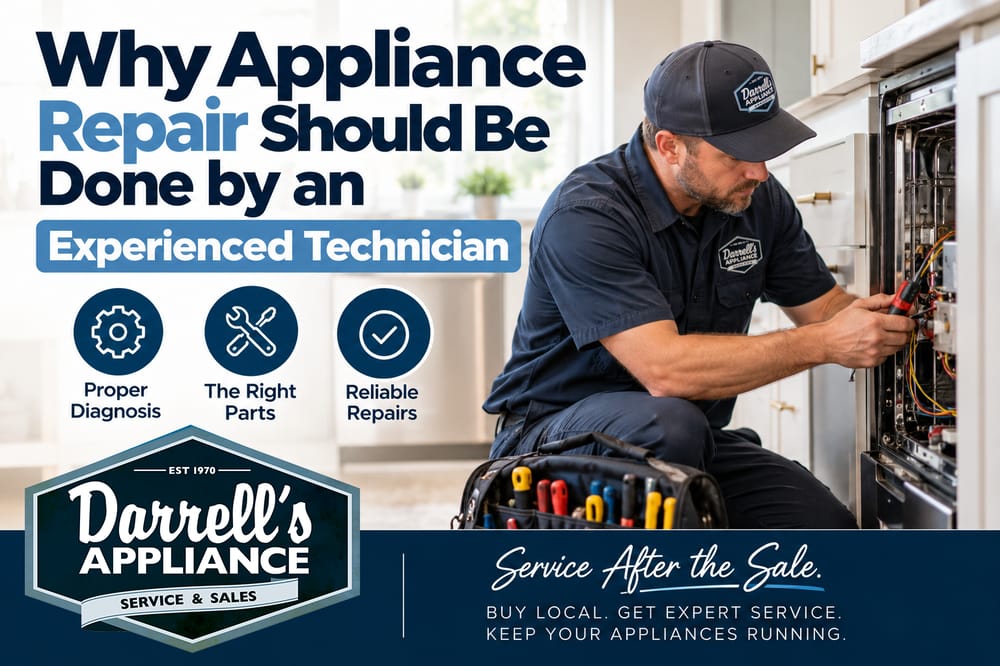
Why Appliance Repair Should Be Done by an Experienced Technician
Before you assume it's time to replace your appliance, consider this: the problem might be repairable, but identifying the actual cause isn't always straightforward.
- Family-owned since 1970
- Local service technicians
- 10,000+ parts in stock
- Service After the Sale
Your refrigerator is running, but your food isn't staying cold.
Your washing machine suddenly stops draining.
Or your oven takes twice as long to cook dinner.
Before you assume it's time to replace your appliance, consider this: the problem might be repairable, but identifying the actual cause isn't always straightforward.
Modern appliances contain electronic controls, sensors, motors, valves, heating components, and other systems that work together. When something goes wrong, several different problems can produce similar symptoms.
At Darrell's Appliance, we believe appliance ownership should come with support long after the purchase. Understanding the value of professional diagnosis, proper parts, and knowledgeable service can help you make smarter decisions about repairing and maintaining your appliances.
1 An Experienced Appliance Repair Technician Knows How to Find the Real Problem
When an appliance stops working correctly, the first symptom doesn't always reveal the underlying issue.
For example, a refrigerator that isn't cooling properly could have an airflow problem, a faulty fan, a temperature sensor issue, or a problem involving another component. A washing machine that won't drain might have a clogged filter, a drain pump problem, or an issue with its controls.
Replacing the first part that seems suspicious may not solve the problem.
An experienced appliance repair technician approaches the situation differently. Instead of guessing, the technician evaluates the symptoms, checks relevant components, and uses appropriate diagnostic procedures to narrow down the cause.
Professional diagnosis can help identify:
- The source of the problem: Determine which component or system is causing the malfunction.
- Related issues: Recognize when one problem may be affecting another part of the appliance.
- The appropriate repair: Determine which repair, if any, is needed to restore proper operation.
- Potential safety concerns: Identify conditions that require the appliance to be taken out of service.
Accurate diagnosis matters because replacing unnecessary parts can increase repair costs without fixing the original problem.
2 Modern Appliances Require More Than Basic Troubleshooting
Today's appliances are more advanced than ever. Many models feature electronic control boards, digital displays, specialized wash cycles, temperature sensors, smart connectivity, and automated diagnostic systems.
These features can improve convenience and performance, but they can also make troubleshooting more complicated.
An error code, for example, may point toward a particular system without identifying the exact component that has failed. A dishwasher displaying an error could have a drainage issue, a sensor problem, or another condition that needs further investigation.
An experienced appliance repair technician understands that troubleshooting requires more than looking up a code and replacing a part.
Depending on the appliance and symptoms, a technician may need to:
- Review the appliance's error codes and operating history.
- Consult the appropriate service information.
- Inspect electrical connections and relevant components.
- Test individual parts using suitable diagnostic methods.
- Evaluate whether the problem is mechanical, electrical, or related to another system.
This knowledge is especially important when working with newer appliances or premium models that use specialized technology.
3 The Right Replacement Part Makes a Difference
Finding the correct replacement part is another important reason to use an experienced appliance repair technician.
Two appliances that look nearly identical may use different components depending on their model numbers, production dates, or design revisions. Even parts that appear interchangeable may have different specifications.
Installing the wrong component can lead to additional problems, wasted money, or a repair that doesn't address the original issue.
A knowledgeable technician considers several factors before selecting a replacement part:
- Model and serial information: Helps identify the correct appliance configuration.
- Part compatibility: Confirms that the replacement is appropriate for the specific model.
- Component specifications: Ensures the part meets the appliance's requirements.
- Underlying cause: Helps determine whether replacing the component will actually resolve the problem.
Depending on the repair, a technician may recommend an original equipment manufacturer (OEM) part or another appropriate replacement option.
It's also important to recognize that a failed component may be a symptom of a larger issue. If the underlying cause isn't addressed, the same problem could return.
A Dedicated Parts Department in Cache Valley
Darrell's Appliance has a dedicated parts department serving Cache Valley and beyond. Having access to the right parts can be an important advantage when a repair is needed.
Learn more about our selection through the Darrell's Appliance parts department.
4 DIY Appliance Repairs Can Become More Expensive Than Expected
When an appliance breaks, searching online for a quick fix can be tempting.
Sometimes, a simple maintenance step is all that's needed. Cleaning a dishwasher filter, checking a refrigerator's temperature settings, or confirming that an appliance is receiving power may help resolve a minor issue.
However, online videos and troubleshooting guides cannot always account for the specific model, symptoms, or conditions in your home.
A repair that appears simple in a video may involve electrical components, sharp metal edges, heavy equipment, water connections, or gas lines.
DIY guesswork can create several problems:
Replacing the wrong partYou may spend money on a component that wasn't causing the issue.
Missing the underlying problemThe appliance might temporarily work again, only for the original symptoms to return.
Damaging other componentsIncorrect disassembly or installation can create additional problems.
Creating safety risksImproper work on electrical, gas, or other hazardous systems can result in injury or property damage.
Complicating future repairsPrevious repairs that were performed incorrectly can make diagnosing the original issue more difficult.
Consider whether you have the tools, knowledge, and service information needed to complete the repair safely.
What Can Homeowners Safely Check First?
Depending on the appliance and its instructions, a few basic checks may be appropriate:
| Appliance | Simple checks to consider |
|---|---|
| Refrigerator | Confirm the temperature settings and make sure interior air vents aren't blocked by food. |
| Dishwasher | Check that the filter is clean according to the owner's manual and that dishes aren't obstructing the spray arms. |
| Washing machine | Check the selected cycle, load size, and whether the load is badly unbalanced. |
| Dryer | Clean the lint filter and check for obvious airflow restrictions that can be addressed safely. |
| Oven or range | Confirm the selected cooking mode and temperature settings. |
| Microwave | Check that the door closes properly and the appliance is being used according to its instructions. |
These checks won't resolve every problem, but they may help you rule out simple causes before scheduling service.
Avoid opening electrical compartments, bypassing safety switches, or attempting repairs involving gas systems or other hazardous components without the necessary qualifications.
When basic checks don't solve the problem, professional diagnosis is the better next step.
5 Professional Repairs Can Help You Avoid Repeated Problems
An appliance that starts working again isn't necessarily repaired correctly.
For example, a dryer that overheats may have an airflow restriction or a problem with a temperature-related component. Simply replacing a suspected part without checking the surrounding system could leave the actual cause unresolved.
Similarly, if a washing machine repeatedly stops mid-cycle, the issue could involve more than one component or condition.
An experienced appliance repair technician looks beyond the immediate symptom and considers what might be causing it.
A thorough diagnostic process can help determine whether:
- A specific component has failed.
- A blockage or maintenance issue is affecting performance.
- Multiple components need attention.
- The appliance has an electrical or control-related problem.
- The appliance needs additional evaluation before a repair can be recommended.
No repair can guarantee that an appliance will never experience another problem. However, identifying the cause before replacing parts can reduce unnecessary repairs and help you make a more informed decision.
That is particularly important when you are deciding whether to invest in a repair or replace an older appliance.
6 A Technician Can Help You Decide Whether to Repair or Replace
When an appliance breaks down, many homeowners immediately wonder whether repairing it is worth the expense.
The answer depends on more than the initial repair estimate.
An experienced appliance repair technician can help you understand the nature of the problem and the work required to address it. With that information, you can compare the repair against the cost of replacement and the condition of your existing appliance.
Consider these factors when making your decision:
- The appliance's age: Older appliances may be more likely to need additional repairs, although age alone doesn't determine whether replacement is necessary.
- The estimated repair cost: Compare the repair estimate with the cost of a suitable replacement appliance.
- The appliance's overall condition: Consider its performance, maintenance history, and whether it has experienced repeated problems.
- Parts availability: Some repairs may be more difficult if the necessary components are unavailable or discontinued.
- Efficiency and features: Replacing an older appliance may provide an opportunity to upgrade, but a newer model isn't automatically the more economical choice.
- Your household's needs: Consider capacity, reliability, convenience, and how long you expect to keep the appliance.
A professional diagnosis gives you a clearer starting point. Rather than making a decision based on a symptom alone, you can evaluate the actual problem and determine which option makes the most sense for your home.
For a deeper look, read Repair or Replace Your Appliance? Start With a Diagnosis.
7 Local Appliance Service Provides Support Beyond the Sale
When you purchase an appliance, you're making an investment in your home. Having access to knowledgeable local support can make a difference when that appliance needs attention.
Darrell's Appliance has served Cache Valley, Northern Utah, and Southern Idaho since 1970. As a family-owned business, Darrell's offers appliance sales and parts support backed by local service and product knowledge.
Choosing a local appliance business means you have a place to turn when questions arise about your appliances, replacement parts, or the next step after a breakdown.
We believe helping customers doesn't end when an appliance leaves the showroom. From selecting the right product to finding parts and getting help when something goes wrong, knowledgeable support matters throughout the life of your appliance.
Whether you're dealing with a refrigerator that won't stay cold, a washer that won't drain, a dishwasher that isn't cleaning properly, or an oven that isn't heating as expected, understanding the problem is the first step toward finding a solution.
When Should You Call an Appliance Repair Technician?
Consider scheduling professional service when:
- Your appliance repeatedly stops working or produces the same error code.
- Your refrigerator or freezer isn't maintaining the correct temperature.
- Your washer won't drain, spin, or complete a cycle.
- Your dryer isn't heating properly or takes unusually long to dry clothes.
- Your dishwasher leaks, fails to drain, or leaves dishes dirty.
- Your oven or range isn't heating consistently.
- You've completed basic troubleshooting but the problem remains.
- You suspect an electrical, gas, or internal mechanical problem.
Don't wait for a minor performance issue to become a bigger disruption. If an appliance isn't operating as expected, a professional evaluation can help you understand what is happening and what to do next.
Frequently Asked Questions About Appliance Repair Technicians
Why should I hire an experienced appliance repair technician?
An experienced technician can use appropriate diagnostic procedures to identify the likely cause of an appliance problem, determine which parts may be needed, and recommend the appropriate repair. This can help you avoid unnecessary part replacements and troubleshooting guesswork.
Is it cheaper to repair an appliance myself?
Not necessarily. While some basic maintenance tasks are appropriate for homeowners, a DIY repair can become more expensive if you purchase the wrong part, damage another component, or fail to correct the underlying problem. Repairs involving hazardous components should be left to appropriately qualified professionals.
How does an appliance repair technician diagnose a problem?
The process depends on the appliance and its symptoms. A technician may review error codes, inspect components, consult service information, and perform appropriate tests to determine what is causing the malfunction.
Should I repair or replace my broken appliance?
The decision depends on the appliance's age, condition, repair cost, parts availability, and your household's needs. A professional diagnosis can help you understand the problem before comparing the cost of repair with the cost of replacement.
Can using the wrong appliance part cause more problems?
Yes. A part that looks similar to the original may not be compatible with your appliance's model or specifications. Using the correct part and addressing the underlying cause are important considerations when completing a repair.
Where can I get appliance repair help in Logan, Utah?
Darrell's Appliance serves homeowners throughout Cache Valley, Northern Utah, and Southern Idaho. Visit the Darrell's Appliance website to learn more about the business, or request a service call.