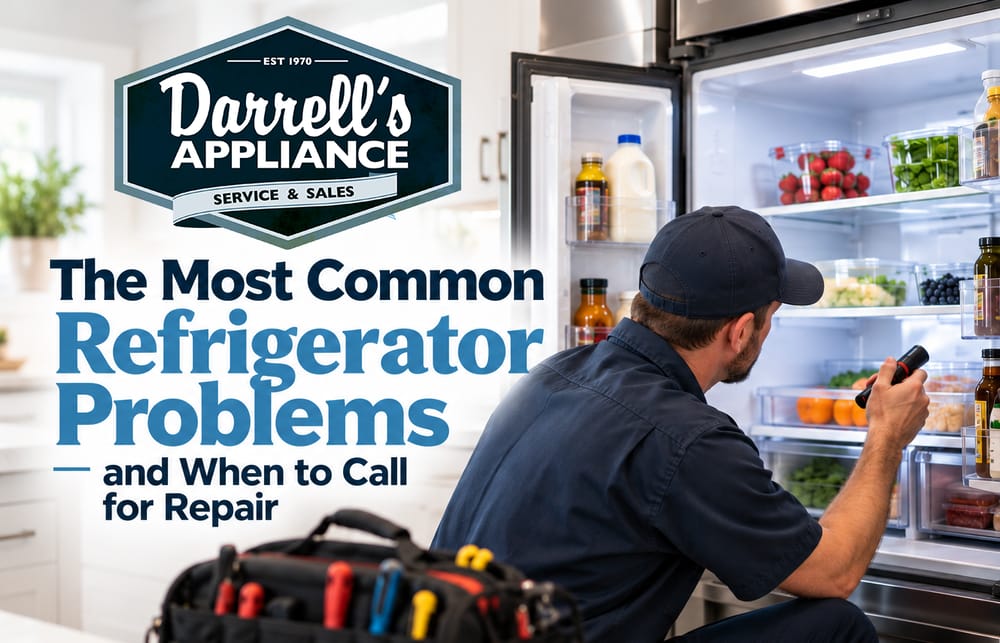
The Most Common Refrigerator Problems—and When to Call for Repair
Not cooling, leaking, making noise, or no ice? Learn which refrigerator problems you can safely check yourself—and when it's time to call an experienced technician.
- Family-owned since 1970
- Local service technicians
- Dedicated parts department
- Warranty support
Your refrigerator is running, but your food isn't staying cold.
"Is it time to replace the refrigerator—or could it simply need a repair?"
That's one of the most common questions homeowners face when their refrigerator starts acting differently. A refrigerator can develop several symptoms before it completely stops working, including temperature problems, unusual noises, water leaks, ice maker issues, and a water dispenser that suddenly stops working.
Some problems have simple explanations that homeowners can safely check. Others require proper diagnosis from an experienced appliance repair technician.
Knowing the difference can help you avoid unnecessary repairs, prevent further damage, and make a more informed decision about whether to repair or replace your refrigerator.
If you're experiencing refrigerator problems in Cache Valley, understanding the warning signs is a good place to start.
Why Refrigerator Problems Can Be Difficult to Diagnose
A modern refrigerator is much more than a box that keeps food cold.
Depending on the model, a refrigerator may have many components working together:
- Compressors
- Fans
- Temperature sensors
- Electronic controls
- Evaporators
- Water valves
- Ice makers
- Defrost systems
- Air ducts
- Filters
That means one symptom can have multiple possible causes.
You may know: The refrigerator isn't cooling properly.
But that doesn't necessarily mean the compressor has failed.
The problem could involve airflow, temperature settings, a fan, a sensor, frost buildup, a defrost system, or another component.
This is where professional refrigerator repair becomes valuable.
1 Refrigerator Isn't Cooling Properly
One of the most urgent refrigerator problems is poor cooling. You may notice:
- Food isn't staying cold.
- The refrigerator feels warmer than normal.
- The freezer seems to be working differently.
- Milk and other perishables aren't staying properly chilled.
- The refrigerator runs almost constantly.
- Ice cream becomes unusually soft.
- Temperatures fluctuate throughout the day.
What You Can Safely Check
Before scheduling service, check a few simple things:
- Check the temperature setting. Someone may have accidentally changed the refrigerator or freezer temperature.
- Check the vents. Make sure food isn't blocking interior air vents.
- Check that the doors are closing completely. A container or shelf item may be preventing the door from sealing properly.
- Check the door gasket. Look for obvious damage, gaps, or debris preventing the gasket from making a good seal.
A cooling problem can have several possible causes, and continuing to operate a refrigerator that isn't maintaining safe temperatures can put food at risk.
When to call for refrigerator repair
If basic checks don't resolve the problem—or if the refrigerator is significantly warmer than it should be—professional diagnosis is recommended.
A technician can evaluate the appliance's cooling system and determine what is actually causing the problem instead of replacing parts based on guesswork.
2 Your Refrigerator Is Making Strange Noises
Refrigerators aren't completely silent. You may hear fans running, ice dropping into the bin, water entering the ice maker, or the compressor cycling on and off.
But a new or unusually loud noise can be worth investigating. Common complaints include:
- Buzzing
- Clicking
- Humming
- Rattling
- Grinding
- Vibrating
- Scraping
- Repeated clicking
What Can You Check?
First, make sure the refrigerator is sitting level and isn't touching surrounding cabinets or walls in a way that could amplify vibration.
Also check whether bottles, containers, or other items are vibrating against shelves.
If the noise continues—or if it sounds mechanical, grinding, or significantly different from the refrigerator's normal operation—it's time to consider professional service. A technician can determine whether the sound is coming from a fan, compressor, motor, ice maker, or another component.
Don't Assume a Strange Noise Is Harmless
Just because the refrigerator is still cooling doesn't mean everything is fine.
Sometimes unusual noises are an early warning that a component needs attention.
3 Water Is Leaking From the Refrigerator
Finding water on the kitchen floor is never a good surprise. A refrigerator leak can come from several places, including:
- Water supply connections
- Drain systems
- Ice maker components
- Water dispenser systems
- A clogged or frozen drain
- A damaged water line
- Improper leveling or installation
What Should You Do First?
- Identify where the water appears to be coming from.
- Check for an obvious loose connection or spill inside the refrigerator.
- If your refrigerator has a water supply, shut off the water supply if there is an active leak and you can safely access the shutoff.
- Then determine whether the water is continuing to accumulate.
When should you call for refrigerator repair?
Call for professional service when you can't identify the source of the leak, the leak continues, or water is getting near electrical components.
4 The Ice Maker Isn't Making Ice
Few refrigerator features are more convenient than an automatic ice maker—until it stops working. You may notice:
- No ice production
- Very little ice
- Small or misshapen ice cubes
- Ice production that stops and starts
- An ice maker that is frozen up
- Ice that gets stuck in the mechanism
Simple Things to Check
- Make sure the ice maker is turned on.
- Make sure the ice bin isn't full or incorrectly positioned.
- Check the refrigerator's water supply if the model requires one.
- If your refrigerator has a replaceable water filter, check whether the filter is due for replacement according to the manufacturer's recommendations.
Don't Immediately Assume You Need a New Ice Maker
The problem could involve the water supply, valve, temperature, control system, or another component. That's where proper diagnosis matters.
An experienced technician can determine whether the problem is actually the ice maker or something upstream that is preventing it from operating properly.
5 The Water Dispenser Isn't Working
A refrigerator water dispenser that suddenly stops working can be caused by something relatively simple—or something requiring service.
Before calling for repair, check:
- Is the refrigerator connected to its water supply?
- Is the water filter installed correctly?
- Is the filter due for replacement?
- Is the dispenser locked?
- Is the water line visibly kinked?
- Is the refrigerator operating normally otherwise?
If the dispenser still isn't working, the problem could involve a water valve, dispenser mechanism, control system, water line, or another component.
Instead of replacing parts based on an online troubleshooting video, professional diagnosis can help determine which component actually needs attention.
6 The Refrigerator Is Too Cold
A refrigerator that's too warm is an obvious concern—but a refrigerator that's too cold can also be a problem. You may notice:
- Lettuce or produce freezing
- Drinks becoming partially frozen
- Water freezing in unexpected areas
- Food developing ice crystals
- Certain areas of the refrigerator becoming much colder than others
Start With the Basics
Start by checking the temperature setting.
Then look at how food is positioned inside the refrigerator. Items placed directly in front of cold-air vents may become colder than food elsewhere.
If changing the setting and rearranging food doesn't solve the issue, the refrigerator may need professional diagnosis. Temperature problems can involve sensors, airflow, controls, or other components.
7 The Refrigerator Is Constantly Running
A refrigerator needs to run regularly to maintain temperature, but you may notice that yours seems to run almost constantly.
Several factors can affect how often a refrigerator runs, including:
- Room temperature
- How often the doors are opened
- How much food is stored inside
- Door seals
- Airflow
- Condenser cleanliness
- Temperature settings
- Appliance components
Before assuming something has failed, check the basics and make sure the doors are sealing properly.
If the refrigerator continues running excessively or isn't maintaining the correct temperature, professional refrigerator repair may be appropriate. A technician can evaluate whether the refrigerator is working normally or whether a component needs attention.
8 Frost or Ice Is Building Up Where It Shouldn't
A little frost in a freezer can happen depending on the appliance and conditions, but excessive or unusual frost buildup can indicate a problem. You might notice:
- Heavy frost on the freezer's back wall
- Ice covering vents
- Drawers becoming difficult to open
- Food becoming covered in frost
- The refrigerator or freezer temperature changing
A Common Mistake
Simply removing the visible ice and assuming the problem is solved. That may temporarily improve airflow, but if the underlying cause remains, the frost can return.
The cause could involve airflow, a door seal, a defrost system, or another component.
If frost keeps coming back, the important question isn't just "How do I remove it?"
When DIY Refrigerator Troubleshooting Should Stop
There are a few basic things homeowners can safely check, but refrigerator repairs can involve electrical components, refrigerant systems, motors, water connections, and other specialized components.
It's time to stop DIY troubleshooting when:
- It still isn't cooling after basic checks
- You hear grinding, repeated clicking, or unusual mechanical noises
- Water is leaking and you can't identify the source
- The ice maker or dispenser keeps malfunctioning
- Frost repeatedly builds up
- It repeatedly trips a circuit breaker
- You smell something burning
- You see damaged wiring
- You suspect an electrical problem
- The repair requires opening internal components
- You're unsure what you're looking at
The goal of troubleshooting isn't to become an appliance technician. It's to determine whether there's a simple issue you can safely address—or whether the refrigerator needs professional attention.
Why Professional Refrigerator Repair Matters
When a refrigerator stops working correctly, it's tempting to search for the cheapest replacement part and follow a video online.
The problem is that the symptom isn't always the cause.
You may know: The refrigerator isn't cooling.
But it could have several possible causes.
You may know: The water dispenser isn't working.
But it may not need a new dispenser.
You may know: The ice maker isn't producing ice.
But the ice maker itself may not have failed.
You may know: The refrigerator is making a strange noise.
But the problem may not be the component that sounds loudest.
An experienced appliance technician understands how these systems work together. Professional diagnosis can help:
- Identify the actual problemInstead of replacing parts based on assumptions, the technician evaluates the appliance and works to determine what is causing the symptom.
- Determine what parts are neededOnce the problem has been identified, the correct replacement component can be selected for the specific appliance.
- Avoid unnecessary repairsReplacing parts that aren't actually defective can become expensive quickly.
- Help you decide whether to repair or replaceA professional diagnosis gives you better information when deciding whether repairing an older refrigerator makes sense.
The Importance of the Right Parts
Even when you know what part has failed, selecting the correct replacement isn't always as simple as it seems. Refrigerators can have multiple model variations, and parts can differ between models or production versions.
Darrell's Appliance has a dedicated parts department serving Cache Valley and beyond.
That local parts knowledge can be especially valuable when you're trying to determine what your refrigerator actually needs.
Buying a Part Yourself?
Have the model number and serial number available. These details help identify the correct component for your appliance.
Repair or Replace Your Refrigerator?
Not every refrigerator problem means you need a new refrigerator. In some cases, a repair can extend the useful life of an appliance. In other situations, replacement may make more sense.
When deciding, consider:
- The age of the refrigerator
- The cost of the repair
- The appliance's overall condition
- Whether it has experienced repeated problems
- Parts availability
- Energy efficiency
- Your family's storage needs
- Features you want in a newer model
- The cost of an appropriate replacement
Want to go deeper? Read Repair or Replace Your Appliance? Start With a Diagnosis.
Refrigerator Repair in Logan & Cache Valley
When your refrigerator isn't working correctly, you don't necessarily need a new appliance. You need to know what's wrong.
Darrell's Appliance is a family-owned appliance business serving Cache Valley, Northern Utah, and Southern Idaho since 1970. The company operates from its location on Airport Road in Benson and provides appliance sales and local support.
Darrell's carries refrigerators from a wide range of brands, including:
- GE
- GE Profile
- LG
- Whirlpool
- KitchenAid
- Sub-Zero
- Thermador
- & others
That combination of product knowledge, parts resources, and local service support helps customers get more than just a refrigerator. It gives them a place to turn when something goes wrong.
Service After the Sale. That's an important part of buying an appliance locally.
You're not simply purchasing a refrigerator and being left on your own. You have access to a local team that understands appliances and can help you determine the next step when your appliance isn't performing as it should.
Buy Local. Get Expert Service. Keep Your Appliances Running.
Frequently Asked Questions About Refrigerator Repair
How do I know if my refrigerator needs repair?
If your refrigerator isn't maintaining the correct temperature, is leaking, making unusual noises, repeatedly building frost, or has an ice maker or water dispenser that isn't working properly, it may need professional evaluation.
Why is my refrigerator running but not cooling?
There are several possible causes, including airflow problems, temperature settings, door-seal issues, frost buildup, sensors, fans, or other components. Basic checks can rule out simple problems, but persistent cooling issues should be professionally diagnosed.
Should I repair or replace my refrigerator?
It depends on the refrigerator's age, condition, repair cost, parts availability, and your household's needs. A professional diagnosis can give you better information before you decide.
Why is my refrigerator making a strange noise?
Some refrigerator sounds are normal, including fans, compressors, and ice-making cycles. A new, unusually loud, grinding, scraping, or repeated noise may indicate a component that needs inspection.
Why is my refrigerator leaking water?
Possible causes can include water supply connections, drain systems, ice maker components, or water lines. If you can't identify the source or the leak continues, professional service is recommended.
Why isn't my refrigerator ice maker making ice?
Check that the ice maker is turned on, the bin is properly positioned, and the refrigerator has an adequate water supply. If it still isn't producing ice, the issue may involve the water system, temperature, controls, or ice maker components.
Can I repair my refrigerator myself?
Simple checks such as verifying temperature settings and ensuring vents aren't blocked may be appropriate. Internal electrical, mechanical, water, and other specialized repairs should be handled by appropriately qualified professionals. Request a service call or call 435-752-9022.